Web flasher
The flasher installs the Halium GSI on a phone from a browser,
over WebUSB, the way GrapheneOS's web installer does for Pixels. It is the
Flasher link in the docs site's navigation bar. It is plain HTML and
JavaScript in website/static/flasher/, which Docusaurus copies to
flasher/ on the site, with no build step and no third-party code.
It needs a Chromium-based browser on a computer (Chrome, Edge, Brave), since only those implement WebUSB, and a phone whose bootloader can be unlocked, that takes GSIs, and that runs Linux 5.10 or newer (launched with Android 12 or later).
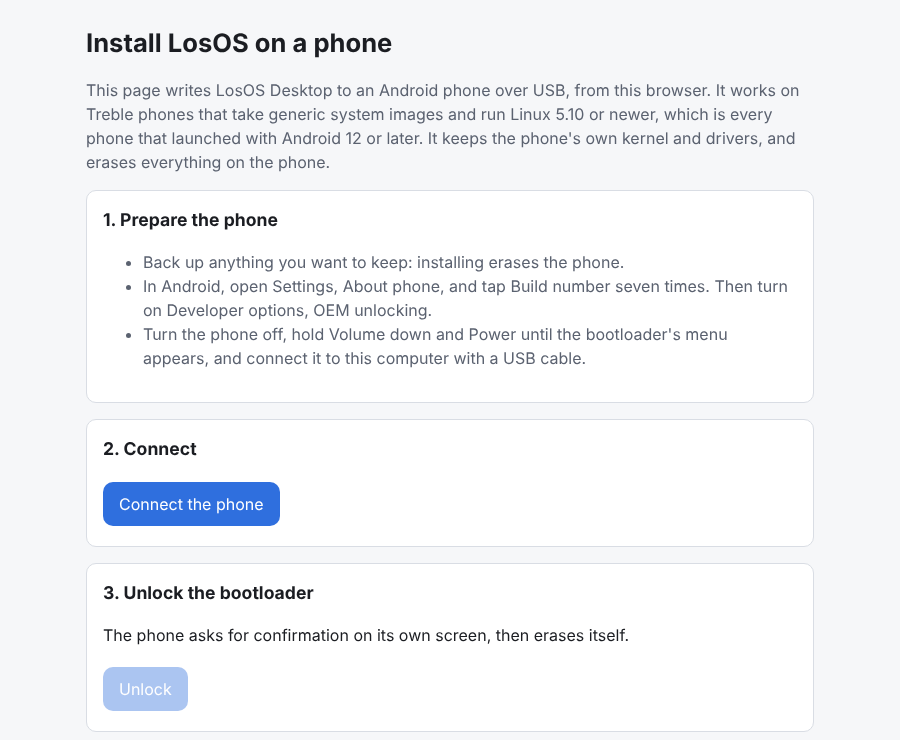
What it does
- Connect. The person puts the phone in its bootloader with Volume
down and Power, and picks it from the browser's USB prompt, which lists
only devices with a fastboot interface. The flasher reads
product,unlocked,current-slot,is-userspaceto tell whether the phone is in fastbootd, and whetherinit_bootandvbmetaexist. - Unlock. For a locked bootloader it sends
flashing unlock. The phone asks on its own screen and erases itself. OEM unlocking has to be turned on in Android's developer options first, and only the phone can do that. - The phone's boot image. This step is only for a phone without
init_boot, where the flasher needs the boot image the phone runs. "Read it from the phone" restarts the phone withreboot-fastbootinto fastbootd, the fastboot inside recovery. Unlike the bootloader, fastbootd can read a boot partition back withfetch, inmax-fetch-sizepieces. The person connects again and the flasher readsboot_<slot>. Alternatively the person choosesboot.imgfrom the factory image of the exact build the phone runs. Either way,bootimg.jsparses the header, readsLinux version x.y.zfrom the kernel, whether raw, gzip with device trees after it, or LZ4, and refuses a kernel older than 5.10. - Get LosOS. The flasher reads the newest release's
SHA256SUMSfrom the proxy and finds the three_gsi-files in it by name. It downloads them into the browser's private file storage, the origin private file system, and hashes them as they arrive. A file whose SHA-256 differs fromSHA256SUMSstops the install. The person can choose files they already have instead, such as the output of a localnix build .#gsi, and they are checked whenSHA256SUMSis among them. - Install. It writes
vbmeta, when the phone has one, andinit_bootto the current slot, thenuserdata. On a phone withoutinit_bootit writesbootinstead. That is the phone's boot image with the GSI's ramdisk, taken out of the release'sinit_boot.img, appended to its own at a 4-byte boundary, and recompressed with gzip when the phone's ramdisk is gzip. The flasher writes the header's ramdisk size,recovery_dtbooffset and SHA-1 id asmkbootimgwould. It drops a v4 header's boot signature, since vbmeta turns verification off. A result larger than the partition stops the install. userdata's own image is gigabytes, and a bootloader takes at mostmax-download-sizeat a time. So the flasher decompresses it as a stream and cuts it into sparse images of at most that size, and never over 256 MiB. Each one covers the whole partition, with "skip" chunks around its own share, as fastboot's own resparsing does. They are written one after another. - Start. It sends
reboot. The first boot grows the root filesystem to the whole of userdata.
It writes nothing else. The phone's kernel, vendor_boot, super and every
other partition stay as they were, and that is why one image fits every
phone.

The bootloader cannot be relocked over this: no bootloader outside Pixels takes
another signing key, and a Pixel's would have to sign init_boot and vbmeta
for LosOS. Every start shows the bootloader's unlocked warning.
Where the files come from
The aarch64 release carries the GSI's files, through release in flake.nix,
so they are pushed, signed and tagged with the rest of it. With a proxy, the
flasher reads them from <proxy>/flasher/<channel>/aarch64/<file>.
Without a proxy, it cannot read them at all. GitHub serves release assets
without Access-Control-Allow-Origin, both from github.com and from the
storage it redirects to. GitHub Pages, which serves the flasher, can only
hold files of up to 100 MB, and userdata alone is over a gigabyte. So the
Download button becomes Open the release on GitHub. It opens the
channel's newest release page, which the site build looked up and
website/release-index.js wrote into flasher/config.json. The person
downloads the three _gsi- files and SHA256SUMS-aarch64 there, and chooses
them with Use files on this computer, which checks them against that
manifest.
The proxy serves /updates/ to sysupdate as redirects to GHCR's storage. A
page can only read a response from another origin if it carries
Access-Control-Allow-Origin, and GHCR's storage does not send it. So
/flasher/ serves the same release, limited to the _gsi- files and
SHA256SUMS, by streaming each byte range the flasher asks for through the
proxy. The flasher asks for 32 MiB at a time, so no request comes near the
function's time limit. Those bytes count against the proxy's Vercel
bandwidth, unlike /updates/, whose bytes never pass through it. Every read
the proxy answers now carries Access-Control-Allow-Origin: *, since all of
it is public and none of it uses cookies. /ping does not carry it.
The proxy's address reaches the page the same way it reaches the image. CI
has it as the repository variable LOSOS_PROXY_URL, docs.yml passes it to
the site build, and the build writes it to flasher/config.json. A build
without it, such as npm start, still installs from files on the computer.
The SHA-256 check is against the SHA256SUMS the same proxy serves. It
catches a broken download; it does not check the release's OpenPGP
signature, which the browser has no key for.